During my prime, when my social media was at its peak and I was averaging hundreds of thousands of views on every video and going viral semi-regularly, my inbox filled up with one very specific kind of message. "Hey girl, you're killing it. Do you have an agency? Can I connect you to my manager?"
You would be surprised which creators were sending me those. I'm keeping their names to myself, for their privacy. But it meant I got to sit on calls with some of the biggest agency owners in this business and hear what they actually offer. If something piqued my interest, I gave it a fair shot, especially when the message came from a creator I'd been following and looking up to for a while. Those moments were surreal: one day you're watching her videos, the next you're on a call with her team.
One of those calls went like this. The agency did chatting only. No socials, no marketing, no strategy: I'd keep doing all of that myself, and they'd handle my messages for about a third of everything the page made. I'd be paid "every two weeks or monthly, depending on where you're located." The pitch ran on reverse psychology: they acted like they weren't sure they wanted me, so that I'd chase them. Then the owner offered to get me a visa to fly to the US and "collaborate with the girls." And after the call, he kept messaging me. He'd send me photos and try to get me into video game sessions with him, out of nowhere. I asked him to stop writing because I wasn't interested in any of that. He pushed a couple more times and then he stopped.
I didn't sign with him. I didn't sign with any of them. Not because every agency is bad, but because nobody had ever told me what to check, so I checked everything, and most of them fell apart by the second or third question.
Now I sit on the other side of the table. MINX is an agency, run by women, for women, and I'm the one taking the calls. So yes, I'm biased, and I'll tell you exactly where. But almost everything you'll find online about agencies is written by agency owners talking to other agency owners, or by creators who got burned and now hate all of us. Nobody answers the question from the creator's side of the call: what do I check before I sign?
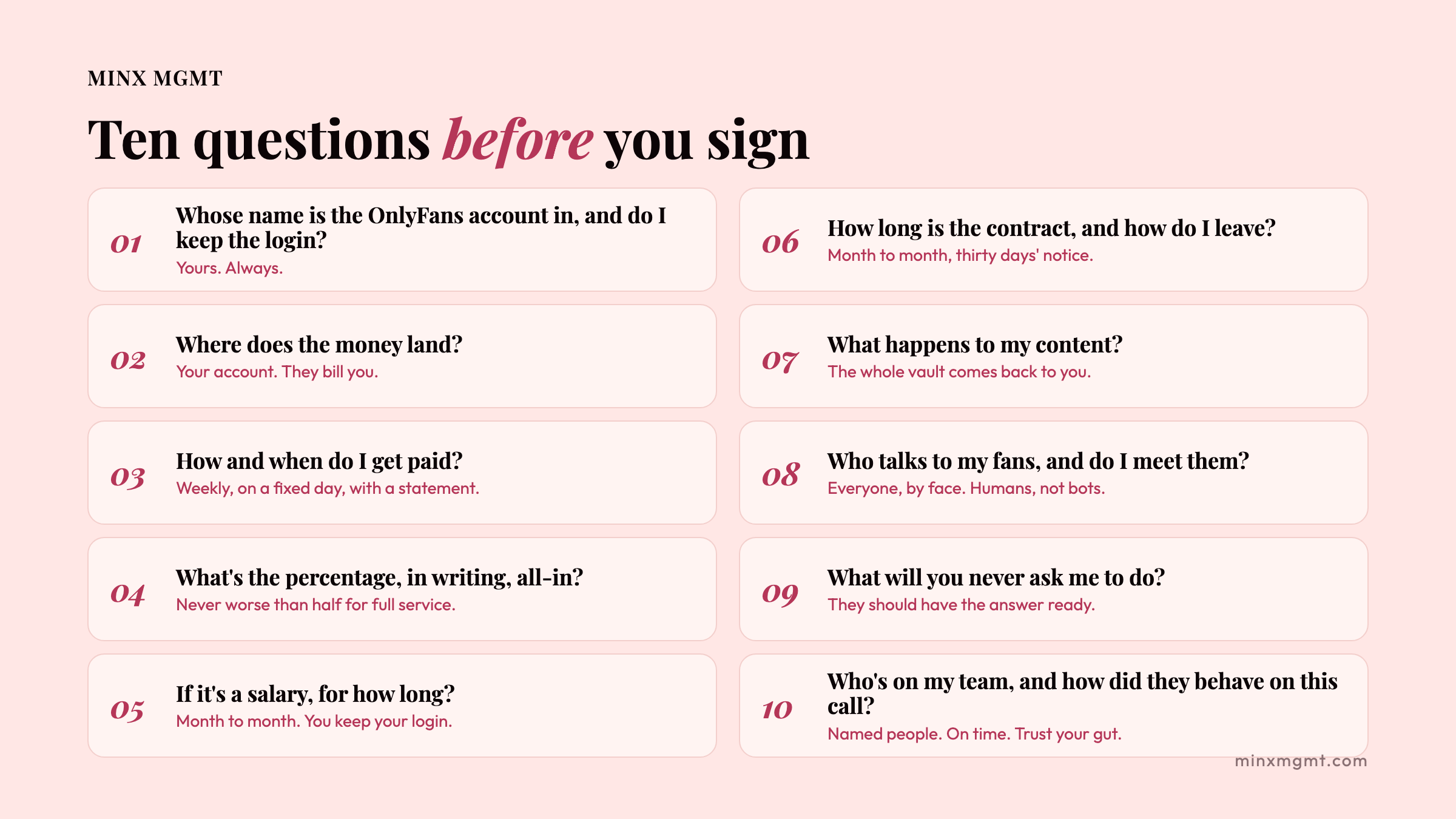
So here are the ten things I'd check, in the order I'd ask them. For each one I'll tell you what a good answer sounds like and what should make you walk. And keep one thing in mind the whole way through: when you sign with an agency on a split, you're taking on a business partner. Treat it that way.
1. Whose Name Is the Account In, and Do I Keep the Login?
This is the first question because it decides everything after it. Your OnlyFans account is in your name, verified with your ID, and you keep the login and the password. Always. It doesn't matter whether the agency opened the page for you from zero or you brought in a page you'd already started: it's yours, you control the logins, and when the contract ends it stays with you. The agency works inside your account with you, never instead of you.
A good answer sounds like: "Your login, your password, your page. We get access. You never lose it." A red flag sounds like: "We'll set the account up for you," or "we handle the login so you don't have to worry about it."
I'll tell you why this one matters so much. One of our creators came to us with two OnlyFans accounts her previous agency had opened for her. She had never been given access to either of them. She didn't even know the brand name they were running her under. When things went sour, the owner deleted the Telegram chat where all her content lived and ghosted her. Missed payments, constant excuses, and then silence. Before we could do anything with her, we had to open a ticket with OnlyFans to get those accounts taken down, and start her from scratch.
That is not a one-off. Countless times we've wanted to work with a creator and she had no clue her previous agency still had control of her account and was still running it. Reclaim, delete, start over. That's the damage an agency can do when the login was never yours.
And here's what it looks like when it's done right: when that same creator later decided to move on from us, she left with her account and every dollar in it. That's the rule here, and it's the rule you should demand anywhere: if you part ways, you leave with your account and everything in it.
2. Where Does the Money Land?
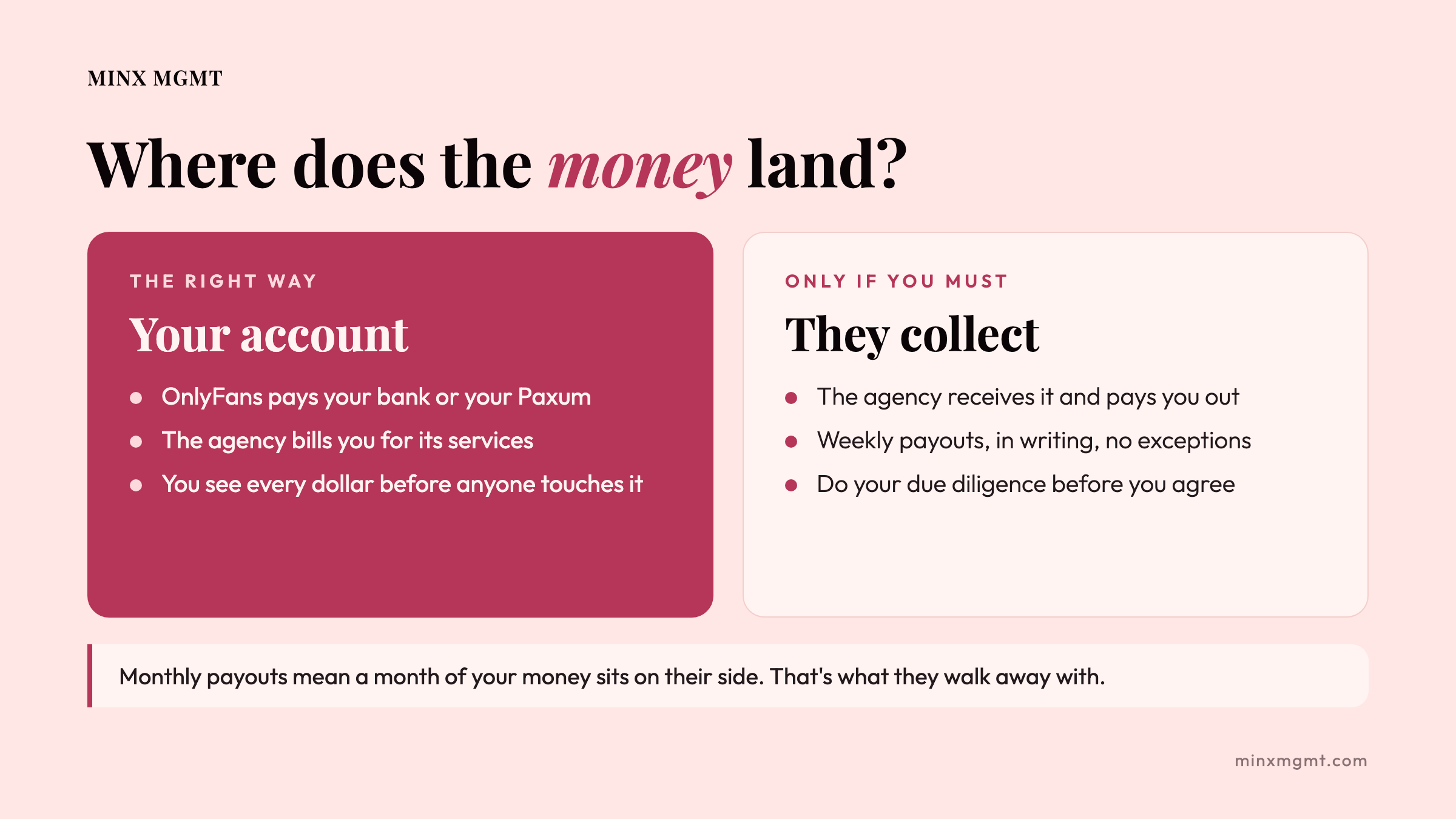
Ask them to draw it for you, literally. The correct way is the simple way: the money from OnlyFans lands in an account in your name, your bank or your Paxum (I covered how to set that up from Latin America here), and the agency bills you for its services. You see every dollar before anyone touches it.
Not every creator is set up to run it that way, especially at the start, and some would rather hand the collecting to the agency so they don't have to think about it. That can work. It's also where most of the horror stories start, so if you go that route, go carefully. Do your due diligence on the agency before you agree to anything of this kind, and demand one thing in writing: weekly payouts. Weekly means your money never piles up on their side. An agency that pays you monthly is holding a month of your money at any given moment, and that's exactly the amount they walk away with the day they ghost you.
3. How and When Do I Get Paid?
Weekly. On a fixed day. With a statement that shows what the page made and what your share was. That's the answer.
Then ask what happens if a payment is late. Here at MINX, if we miss a payday you can leave: no penalties, no retainer, no questions asked, and it's in writing. An agency that pays "every two weeks or monthly, depending on where you are" (yes, that was a real answer I got) is telling you the payday depends on them, not on you.
Ask for the paperwork too. A real company collects a tax form from you before the first payment (the W-8BEN if you're outside the US, which I explained in the article on getting paid) and sends you a statement you can keep. An agency with no statements has no accounting, and an agency with no accounting will lose your money without even meaning to.
4. What's the Percentage, in Writing, All-In?
The question everyone asks first. I'm answering it fourth on purpose: the percentage only means something once you know whose name is on the account and where the money lands. A great split on an account you don't control is a great split for them.
Here's the math from my side of the table. For a full-service agency, the kind that runs your socials, your fans, your protection and your money, do not accept anything less than 50/50. Some agencies do 60/40, sixty to them, and the extra ten percent is "to cover operational costs." But operational costs are their entire business. I run an agency, and I'll be honest with you: working out the exact cost of each account is hard. Software subscriptions to keep the accounts running, ads, people. It gets grey fast. So I keep the math simple. Fifty-fifty, and from our fifty we cover every expense. Realistically that leaves us with something like a thirty to thirty-five percent margin after costs, but that's not your concern. Your concern is that whatever the monthly number on your OnlyFans statement says, half of it is yours. You earned it. Our job is to get better at growing your account without burning through our half.
An agency keeping 65% is abuse. I don't care what they're promising you.
And 50/50 is only for full service. The percentage should move with how much the agency actually takes on. If you're an excellent marketer who already dominates her own socials and you only need help with the messages, then you're looking for a chatting agency, and you should be paying twenty to thirty percent, thirty-five at the very most, for that alone. Here's how to judge whether they're worth it: a competent chatting team should make what comes in from messages and tips at least five times what your subscriptions bring in, and at the top end, ten times. (That's where the money is, remember.) A team that gets you those numbers has earned its twenty to thirty-five. A team that doesn't has earned nothing.
Whatever the number is, get it in writing, all-in, with no hidden fees. "It depends on your profile" is not a number.
5. If It's a Salary, for How Long?
Some agencies won't offer you a split at all. They'll offer a salary: a fixed weekly amount, and you focus only on your homework, which is making the content they'll market and sell.
A bit of history, so you know what you're looking at. Salary deals were everywhere at the start of this business, when OnlyFans was on easy mode. The agency kept its margins high, the creator got a steady cheque, and everybody called it fair. Since the Meta crackdowns and the flood of new creators into the market, we see fewer and fewer of them. Between AI being able to generate an endless stream of content and the market being drowned in it, paying a salary for content alone is a lot less attractive to an agency. The game got harder. Most serious agencies are now looking for a creator with a real talent or a marketable skill, not another Sophie Rain copycat planning to recreate 2021 by dancing to the latest TikTok trend. (I wrote about being cleverer than the 2021 playbook here.)
So if a salary deal does land in front of you, it usually means the agency sees real potential in you and wants you to pour your time into the content. That can still be a good deal. Here's what I'd check before signing one.
Month to month. The salary contract renews monthly, or at the very most every three months, before you sit down and renegotiate a percentage. Nobody locks you on a fixed wage for a year.
You keep your login. It should go without saying, but on a salary deal it matters even more: you need to see your own numbers so you know how the account is performing, and so you walk into the renegotiation knowing exactly what you're worth. Being on salary does not mean being blind.
Know when to ask for the switch. Let them recoup first. I'll say this as an agency owner, so take it with the bias included: an agency that puts you on salary has invested in you, probably with no return for the first month or two while they set up your account. The tech, the people, the energy. Let that come back to them. But if you see an astronomical jump in your revenue, that's your moment to move from salary to a split, and don't accept anything less than 50/50 when you do. If you want a number: the moment your account passes seven thousand dollars a month, start asking for the change.
One of my own red flags: when you're clearly making enough money and they still have you on a salary. At that point they're not investing in you anymore. They're keeping the difference. Ask for the split.
6. How Long Is the Contract, and How Do I Leave?
Month to month. That's the whole answer. Here at MINX we don't believe in year-long contracts: if you want to cancel our services, or move to another agency, you give thirty days' notice and you go. That's how it should be with any agency you ever work with.
Ask it on the call, in those words: "What happens if I want to leave?" A good agency answers in one sentence. A bad one starts talking about "commitment" and "minimum terms," or the question makes them visibly uncomfortable.
The thirty days matter in both directions. An agency that has invested in you deserves a wind-down period to close things out properly, and thirty days is fair. Anything longer is a red flag. No exit fees. No "we keep the account for six months after you leave." No auto-renewals buried on page nine.
7. What Happens to My Content?
Everything you record for the feed, the PPVs, the edited clips for your socials: ask what the agency can do with it while you're together, and what happens to it after.
Here's the honest version, because I've watched other agencies dodge this question. While we work together, everything you send us belongs to the agency to market and sell. It's in the contract, and it has to be: an agency that needed your consent for every single clip before posting it or selling it couldn't run your account at all. The whole point of the partnership is that we use your content to make money for both of us.
What you should check is the ending. When the contract ends, the entire vault of content you gave us gets handed back to you, and you get thirty days to back it up and download it before we delete it from our storage for good. That's the fair version. The creator I told you about got the opposite: her agency held the only copy of everything she'd made in a Telegram chat, and deleted it. So keep your own copy of your content from day one, under your own name, and ask any agency before you sign: when this ends, how does my content come back to me?
8. Who Talks to My Fans, and Do I Get to Meet Them?
This is the question most creators never think to ask, and the one that decides whether your fans stay.
Most creators never even meet the assistants who handle the chats on their page. Here at MINX, you meet all of them, and you put a face to every name. I don’t think it’s something nice that we do just because it “feels good” to know who is managing your account: those people represent you every single time they talk to one of your fans, so you should be deeply invested in who they are. From day one you're in a dedicated group chat with the team working your account, and we've seen it over and over: the accounts that perform best are the ones where the creator and her chat team have a real relationship and work together to give the fans the best possible experience. If an agency won't let you meet the people who are chatting and managing your account for you, that's a red flag. Walk away.
Ask about AI too. A lot of agencies are now quietly switching to AI chatbots. We've tried them. We don't get the same results, and I'd go as far as to say they are absolute garbage next to a real competent human. Maybe the technology will get there one day, but right now as of October 2026, a human beats the bot nine times out of ten. Response time, personality, charisma, wit, persuasion, and the small things, like a fan sending a video, a photo or a voice note and getting a real reaction back, which a bot simply can't give to your fan.
And one more line from my own list: if an agency wants to arrange meetings with subscribers without your consent, that's not a red flag. That's the exit.
9. What Will You Never Ask Me to Do?
Ask it exactly like that, and listen to how long it takes them to answer.
Your boundaries on content are yours. You decide what you're comfortable recording, and no agency should push you past it. Not "just this once," not "the fans are asking," not "it's what sells." Here the rule is simple: we don't force you into content that makes you cringe. Your niche gets built around what you're actually good at and genuinely enjoy, because that's the only kind of content you can keep making for years. (I said it in my very first article: be true to yourself, that's how you stay in the game.)
An agency that crosses that line in the first month will cross every other line after it.
10. Who Exactly Is on My Team, and How Did They Behave on This Call?
You should be able to meet every person who's going to work on your business, by name and by face. A real team, named and accountable. Anonymous Telegram handles with goofy 2d graphic display photos are not a team.
And then there's the part nobody puts in a checklist, so I'm putting it in mine: how they behave. This one is straight from my own experience, on more than one call.
The agency owner, almost always a man, flirting with you on the call. Hitting on you. Trying to get you into random video game sessions with him afterwards, like the one from the beginning of this article. That is not a business partner. That's a man who found a new way to get your attention, and your account is the excuse.
Then the amateurs. They set a time and show up thirty minutes late. They reschedule last minute. They take forever to reply to a simple message. Think about what that means. This is their first impression, the moment they're supposed to be winning you over. If this is how they behave now, imagine later, when you're waiting for your payment and they're "going to get back to you." Or when you're locked out of something, you need help, and they take an eternity.
Signing with an agency on a split is taking on a business partner. Vet them like one. Pay close attention to the demeanour of the people you're about to work with, and if you get that weird feeling in your stomach, the one that says you don't quite trust them, listen to it. Say no and walk away, even if the deal looks really good on paper.
It goes both ways. If an agency reaches out to you, be a professional too. Show up on time, be ready five or ten minutes early, give them your best, and show them you're ready to take this path seriously. First impressions are everything, in both directions.
What About Webcam Studios?
If you're in Colombia, "agency" might mean a webcam studio to you. I'll be honest: we don't have much experience with studios. We've worked with a creator who came from one, but we do everything remotely and a studio needs you in a physical place, so it's a grey area for us and I won't pretend otherwise. What I will say is this: OnlyFans is a far better opportunity than webcam. It's more complex on the business side, but with that complexity comes far more reward, mostly because you get to leverage your time. A studio locks you in six to twelve hours a day in front of a live audience, and you collect a fraction of what you could make working more intelligently, with a real team and real systems behind you, so that you can actually enjoy your life instead of spending most of your day in a dark room recording. If you're considering a webcam studio, please reconsider. Your time is worth more than that. (I wrote a full article on webcam versus OnlyFans if you want to go deeper.)
The Short Version
Ten questions, in order. The first one they fail is the one you walk on.
- Whose name is the OnlyFans account in, and do I keep the login? Yours. Always, whether they opened it or you brought it.
- Where does the money land? Your account, and they bill you. If they collect, weekly payouts, in writing.
- How and when do I get paid? Weekly, fixed day, with a statement. A late payment means you can leave.
- What's the percentage, in writing, all-in? Never worse than half for full service. 65% is abuse. Chatting only: 20 to 35%.
- If it's a salary, for how long? Month to month, three at most. You keep your login. Renegotiate when the numbers jump.
- How long is the contract, and how do I leave? Month to month, thirty days' notice, no exit fees.
- What happens to my content? While you're together, they market and sell it. When it ends, the whole vault comes back to you, with time to download it.
- Who talks to my fans, and do I meet them? Everyone, by face. Humans, not bots. No meetings with subscribers without your consent.
- What will you never ask me to do? They should have the answer ready.
- Who exactly is on my team, and how did they behave on this call? Named people. On time. Professional. Trust your gut.
If you're reading this from inside a bad deal, you're not the first. We've helped creators get out of predatory agreements before, and we know the difference between a contract and a trap. Fill out the form on our homepage, explain your situation, and we'll see if there's something we can do to get you free and independent with your own account. And if you'd rather have an agency that you know has your back, by women, for women, the same form works for that too. Either way, subscribe to the newsletter so you don't miss what comes next.
Besos!
Mari Minx